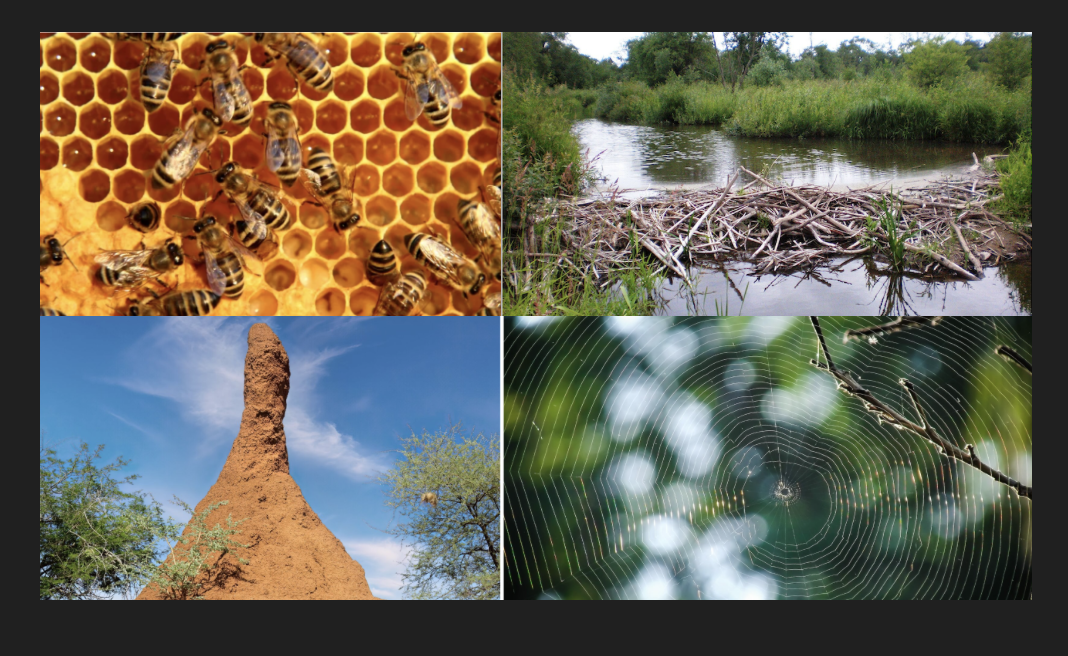
Termites build mounds, beavers construct dams, bees assemble hives, and spiders weave webs. The drive to build is ubiquitous in the natural world and is an evolved strategy to cope with uncertain, complex, and dangerous habitats. This force, known as niche construction, reduces the environment to manageable and predictable units, shields organisms from known risks, serves as a hedge against the vagaries of the environment, and decreases the cost of physiological, cognitive, and psychological homeostasis. Termite mounds serve as de facto external lungs and elaborate ventilation systems, beaver-engineered dams and canals modulate water flow to generate transportation capacities and finding resources, spiders weave webs to locate and capture prey, bees store honey – the most concentrated and easily preserved natural source of carbohydrates – from sourced nectar to protect against variation in nectar supply.
Humans are the paradigmatic niche constructors of the biological world. In fact, niche construction by controlling fire, cooking food and externalized the process of digestion is hypothesized for the three-fold increase in brain size that led to our species. However, in contrast to other animals, our niches are not just limited to physical constructions. Due to our unique capacities of cumulative culture and symbolism, our culture as a whole represents an elaborate set of nested, contested, and interwoven niches (future essay). Social institutions, religious or political ideologies, and scientific theories are all examples and expressions of constructed niches. Vying for space in the “hearts and minds” of cultural agents. These symbolic constructs direct attention, inform perception, bolster memory, scaffold learning, influence actions, and ultimately determine cognition (next essay). Our culture, although cumulative over the long-term, is not necessarily progressive, not always optimally adapted, but always a battleground where intra-generational, intergenerational, and niche-agent mismatches are played out (future essay).
Fundamentally, niches function to diminish threats and minimize the cognitive, psychological, and energetic burdens of homeostasis. Over the 300,000 year evolutionary history, our socio-technologically constructed niches have not only transformed every ecosystem on the planet but have essentially rendered the natural world to the background – as a place to visit, exploit, or conserve. Innovations such as the microscope and germ theory, sanitation systems and vaccines, have relegated dreaded and dreadful parasitic agents of human disease such as cholera, malaria, bubonic plague, and smallpox into the background. Inventions such as temperature controlled buildings, refrigeration, and supermarkets have made homeostatic resources such as calories, micronutrients, temperature, and salt predictable and easily accessible. For the developed world, famines and micronutrient deficiency have receded in magnitude and mind.
By most measures – life expectancy, population, material wealth (GDP), poverty – our niches have been an unequivocal boon to our species. However, a more nuanced examination of history or the metrics show that trade-offs abound and any inferences of hegemony is likely a product of selection bias and have a hue of false security. Deforestation by controlled fire increased the prevalence of malaria. Large scale populations huddled in cities enabled smallpox, cholera, and the bubonic plague to become powerful agents of human morbidity and mortality. Pumped by the misuse of antibiotics and an overly-sterile environments, mutating microparasites lurk and autoimmune diseases are on the rise. The easy access to calorically dense foods optimized to taste and manufactured psychotropic substances engineered to hijack the brain reward and liking systems by the capitalist incentive schemes is leading to the diseases of despair and an epidemic of diabetes and heart disease. Cancer continues to persist despite a century of onslaught by the biomedical sciences and neurodegenerative diseases appear to be an unavoidable sequelae of aging. We seem to have exchanged a delayed mortality for an increased morbidity.
Niche construction is pervasive in nature and operates at all scales and all levels of biological organization. It is an attempt at predictability, agency, and efficiency in an intrinsically unpredictable and treacherous world. For humans, because of our capacity to inherit culture with a mind built for symbolism, plasticity, hybridization, and extensibility (future essay) our constructed niches have enabled us to colonize and exploit every ecosystem on the planet. They have minimized threats from microparasites and reduced the burdens of homeostasis. However, this separation of “us” from “them” is largely symbolic. The biological world is fundamentally dynamic, built on co-evolutionary principles, and innovations have trade-offs. Due to the limitations of foresight and the power of chance, the law of unintended consequences holds an iron grip on both the natural and the derived social world. As Jorge Luis Borges famously said, “nothing is built on stone; All is built on sand, but we must build as if the sand were stone.”
Suggested Reading
Animal Architects: Building and the Evolution of Intelligence
The Tinkerer’s Accomplice: How Design Emerges from Life Itself
Discover more from S-Fxn
Subscribe to get the latest posts sent to your email.

 S-Fxn
S-Fxn 
[…] surprise and novelty, and its products reduce the demands of physiological and psychological homeostasis. Utilizing the various apparati available to organisms, types of cognition abound throughout the […]