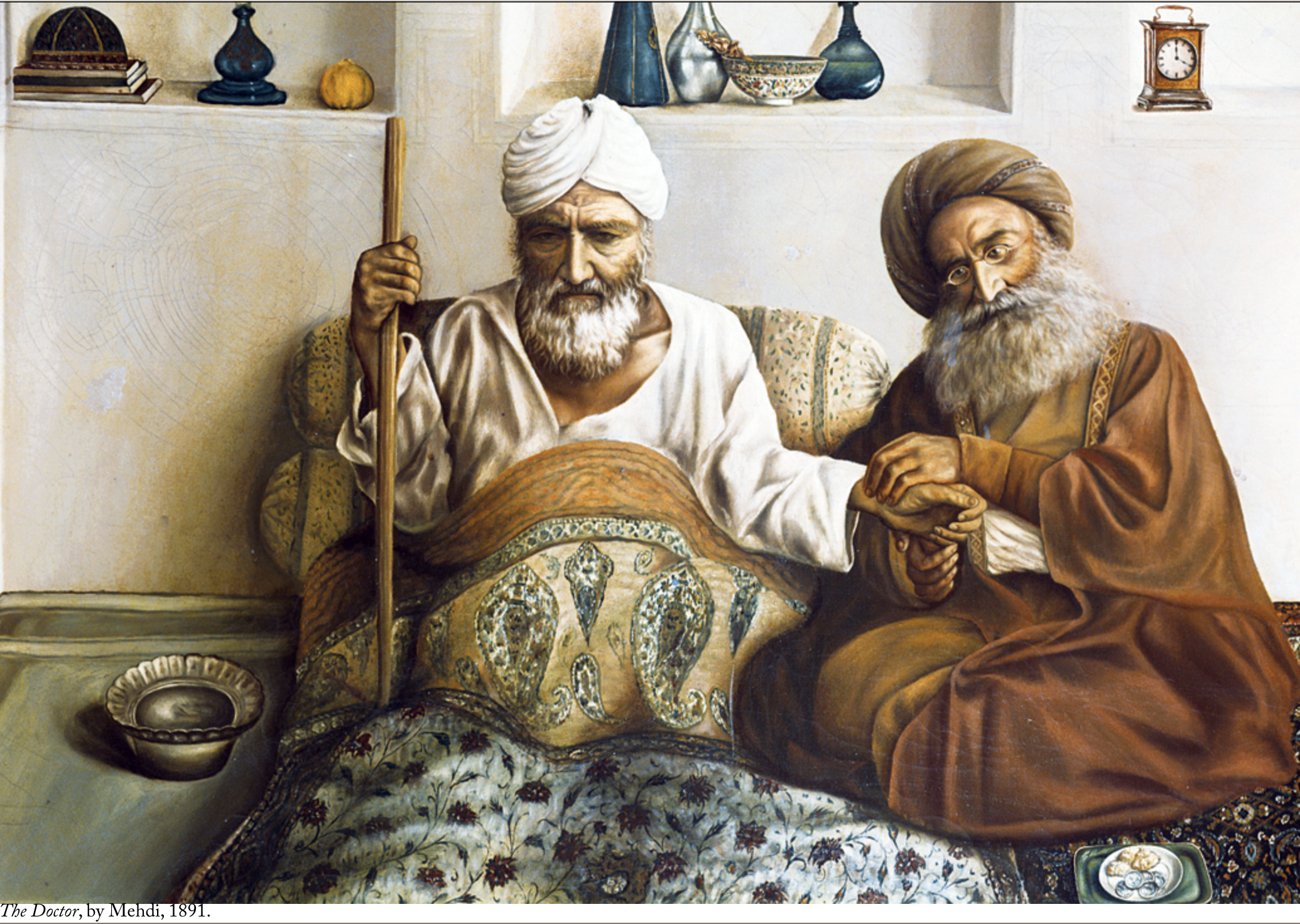
The history and physical exam are firmly established methods in the practice of medicine, with an ancient pedigree. Their origins can be traced 2500 years ago to Hippocrates, who naturalized the concept of disease and introduced the methodology of the history and physical exam. Diseases no longer needed divine explanations, but could be studied like other natural phenomena – via questions, observation, and examination. The history consisted of asking patients questions because “with the help of these questions one will know more exactly some of the things that concern the disease…One will obtain a certain notion of the disease process and of the body site affected.” The physical exam was a natural complement to the history. By examining the patient, the physician was able to augment the history and glean further insight into disease states and trajectories.
Building on these foundations, the physical exam has progressively expanded in scope and increased in refinement. It now consists of the vital signs – respiratory rate, temperature, blood pressure, pulse oximetry, and heart rate – and a systems based head-to-toe exam designed to elicit signs of disease. Technologies such as the thermometer, the sphygmomanometer, and the pulse oximeter have made the measurement of vitals signs more accurate and easier. The stethoscope – invented in 1816 – extended perception, so physicians could listen to heart and lung sounds. Over time, other sensory modalities were trained to recognize patterns that correlated to specific diseases. In effect, expanding the set of affordances.
The vital signs are the most objective features of the physical exam and abnormal values have repeatedly shown to have prognostic value. Unsurprisingly, they are also a key feature in triaging patients who present to the emergency department (ED). The Emergency Severity Index (ESI) is a widely used triage – risk screening – tool in the ED. It is a five category classification system that sets the explicit tempo and the implicit tenor of the ED visit. Patients with ESI scores of “1” and “2” are prioritized entry into the ED, whereas a score of “4” or “5” are assigned to lower acuity areas such as the “fast-track” and are predicted to utilize fewer resources. Thus, accurate and regular measurements are high priorities for the goals of the ED. Despite such value, many of its components can be unreliable in the ED setting. For example, pulse oximetry can be undependable in critically ill or acutely agitated patients. Oral or axillary temperatures are inadequate measures of core temperature. Blood pressure readings are imprecise for severely obese patients. Even outside of these limitations, the constraints of wired vital sign sensors for patients who are often boarding in hallways, moved to and fro, often agitated and in pain is an untenable task and yield measures that are errored, incomplete, and noisy.
In contrast to objective vital sign measures, physical exam findings are more dependent on skill, interpretation, and inference. The physical exam not only requires a skilled practitioner to perform, but also an experienced interpreter to evaluate the signs elicited from the exam. Much of medical education and training is devoted to the development of physical exam skills and interpretation. For example, the constellation of motor and sensory deficits found on a neurological exam allow physicians to identify the location of the pathology in the nervous system. Or the location of tenderness on an abdominal exam and associated findings such as “rebound” or “guarding” not only narrows the differential diagnosis but also refines it. The stethoscope the ability to augment bodily sounds and enabled the development of signs such as wheezes, rales, and murmurs which point towards specific heart and lung pathologies and away from others. However, findings on a traditional physical exam have wide variability sensitivity/specificity (here and here) and in many ways are not fit for the realities of the ED. For example, why bother taking the time to distinguish between a rub and a gallop, a rhonchi and a rale, hyperreflexia o
The medical history serves as a complement to the physical exam and like the physical exam is dependent on skill and inference. It is the point of contact between a physician and a patient and serves as the foundation of this relationship. For patients, it is an opportunity to acquaint their physicians with their inner experiences, to describe their inner sensations, to put into words their interoceptive models, to have their individuality perceived. Although straightforward in appearance and obvious in importance, this process is fraught with pitfalls and errors in perception. The patient must traverse the often unbridgeable chasm between felt experiences and interoceptive states – the conscious and the preconscious. They must also describe those felt experiences in a manner by which the physician can associate and categorize them accurately. In order to accurately bridge these gaps, physicians must not only learn the open-ended question and answer techniques of history-taking, but also have a trained and tuned theory of mind which is attuned to the constellation of verbal symptoms and non-verbal signs that constitute this interaction. However, the wide availability of historical data in the EHRs (upcoming essay) has largely marginalized the perceived utility of the history. Why bother with a patient description of chest pain when I have access to documentation from a prior presentation of chest pain and results of a recent stress test?
Although the history and physical exam (H&P) is a foundational tool in the practice of medicine its value has increasingly decreased for the emergency physician. In the eyes of physicians, the training, time, and performance cost is not commensurate to the information gain. It is easier and even incentivized to order a biomarker test or a radiological study (upcoming essay) in lieu of obtaining an informed history or conducting an incisive physical exam. However, I believe this is an error of misperception and overall system mechanism design (upcoming essay). The value of a discerning and insightful H&P go beyond the material, the immediate, and the measured and to the intangible, the distant, and the unmeasured. The H&P affords the construction of a differential diagnosis that is calibrated to the patient. It is an opportunity to recognize signs of low prevalence, high morbidity diseases, and also atypical presentations of high prevalence and high risk diseases. It can be a key step in screening and derisking under-differentiated emergency patients. In terms of the under-measured, it is an opportunity to minimize the impacts of false positives. In terms of the intangible, a compassionate and humanistic interaction allows the development of a therapeutic alliance and the establishment of trust. Factors that are key in harnessing the benefits of the placebo (future essay) and the exploration of patient values with respect to risk, uncertainty, iatrogenesis, and counterfactual health trajectories (future essay).
The H&P seems quaint and anachronistic in technology focused western medicine, and even more so, in the industrialized environment of the emergency department. Its value is becoming increasingly ignored and its utilization mostly performative. However, the H&P should remain an important tool for the emergency physician, especially if it can be reformed and augmented with technology. If operationalized appropriately it can open up a unique space of affordances. It can identify anomalous presentations, it can minimize the downstream effects of false positives, and can be placebogenic. It can be a key tool for risk identification and derisking. Wireless technologies that enable regular and consistent vital signs measurements, the development of technology to augment physical exam findings so they are prescriptive and proscriptive (next essay), and the implementation of technologies that makes history-taking empathic to the patient (future essay) and predictive to the physician.
Discover more from S-Fxn
Subscribe to get the latest posts sent to your email.

 S-Fxn
S-Fxn 
[…] physiological and pathological processes. As a diagnostic and prognostic modality, they augment the history and physical exam. If utilized as designed, they can expand the set of affordances available to […]
[…] other hand, risk-stratification scores are designed to integrate patient generated data such as the history, physical exam, and biomarker results to quantify and categorize risk. Both these tools are key components of ED […]
[…] this practice of medical recordkeeping, but built on its content by introducing the notion of disease dynamics. They recognized that diseases have typical and natural trajectories. They not only documented the […]